How does a golf handicap work in England?
Your golf handicap, properly called a Handicap Index, is a number that shows your demonstrated playing potential rather than your average score. It comes from the best 8 of your last 20 rounds under the World Handicap System (WHS), and is then converted into a Course Handicap for the exact course and tees you're playing that day.
By Chris, Golf Metric · Updated 23 September 2026 · Facts checked 23 September 2026
What your Handicap Index actually measures
A Handicap Index is a single number, such as 10.4 or 18.2, and it tells you what you are capable of shooting, not what you usually shoot. It comes from your best 8 rounds out of your most recent 20, so it reflects your potential rather than an average dragged down by your worst days on the course. A player with an Index of 0 (a scratch golfer) is expected to play at par or better; an Index of 18 means you are expected to play to around 18 strokes over par on a course of standard difficulty.
How a round becomes a score differential
Every round you submit is turned into a Score Differential, the building block your Handicap Index is made from:
Score Differential = (113 ÷ Slope Rating) x (Adjusted Gross Score − Course Rating − PCC)
Course Rating is the score a scratch golfer is expected to shoot on that course; Slope Rating shows how much harder the course plays for a bogey golfer than for a scratch golfer, on a scale from 55 to 155, with 113 as the standard middle point. PCC is the Playing Conditions Calculation, explained below. The lower the differential, the better the round measured against that particular course. Course rating and slope, explained covers Course Rating and Slope Rating in more detail, with a worked example.
Best 8 of your last 20
Your Handicap Index is the average of your best 8 Score Differentials from your last 20 rounds. Until you have played 20, a sliding scale applies:
| Scores in your record | Differentials used |
|---|---|
| 3 to 5 | Lowest 1 |
| 6 to 8 | Average of lowest 2 |
| 9 to 11 | Average of lowest 3 |
| 12 to 14 | Average of lowest 4 |
| 15 or 16 | Average of lowest 5 |
| 17 or 18 | Average of lowest 6 |
| 19 | Average of lowest 7 |
| 20 | Average of lowest 8 |
Every acceptable score you submit, in a club competition or general play, feeds into this record and your Handicap Index updates the same day.
Net double bogey caps a bad hole
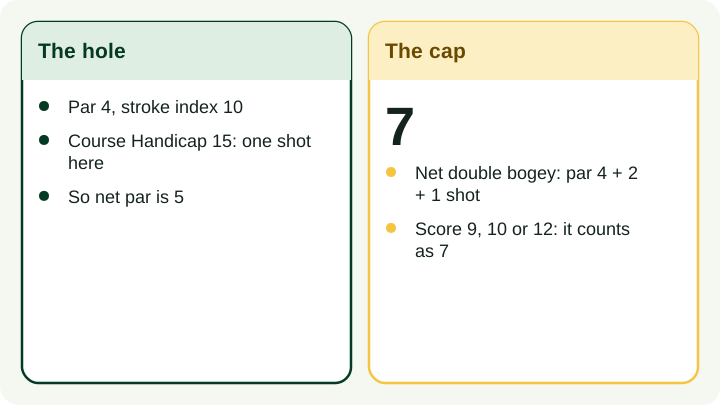
Before a hole score counts towards your handicap, it is capped at net double bogey: double bogey (two over par) plus any handicap strokes you are entitled to on that hole. If your Course Handicap is 15, you get one stroke on the 15 hardest holes on the card, so on a par 4 with a stroke index of 10, your maximum score for handicap purposes is double bogey (6) plus your 1 stroke, which is 7. If you are still working towards your first Handicap Index, the cap is simpler: par plus 5 on every hole. Either way, one disastrous hole cannot wreck your handicap the way it can wreck your card.
Playing Conditions Calculation
The Playing Conditions Calculation, or PCC, is an automatic daily adjustment worked out from every score submitted at a course that day. If scores across the field were unusually high, perhaps because of wind or a soaked course, the PCC nudges everyone's differential down a little to reflect that conditions, not just play, were tougher than the Course Rating assumes; if scores were unusually low it can nudge them up. You never set it yourself, and most days it makes no adjustment at all.
From Handicap Index to Course Handicap
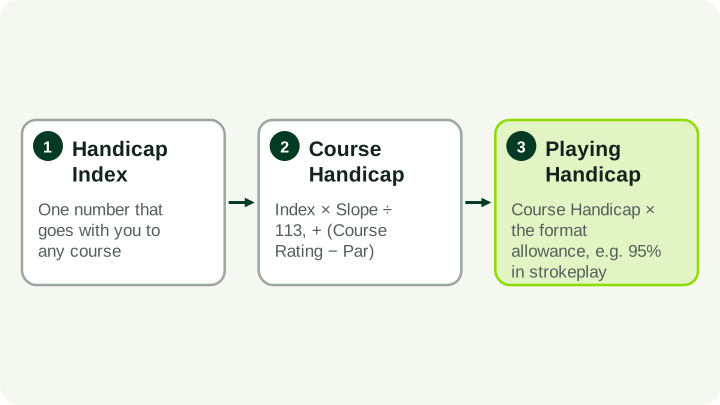
Your Handicap Index is general. Your Course Handicap applies it to the specific course and tees in front of you:
Course Handicap = (Handicap Index x Slope Rating ÷ 113) + (Course Rating − Par)
Most clubs display this on a board or a chart at the first tee, and the MyEG app works it out automatically if you hold your handicap through iGolf. If the Course Rating is above par, you get a few extra strokes; if it is below par, you get slightly fewer.
Course Handicap to Playing Handicap
Your Course Handicap is not always the number of strokes you actually play off. Most formats apply a percentage allowance to it to produce your Playing Handicap:
| Format | Allowance |
|---|---|
| Individual strokeplay or Stableford | 95% |
| Fourball better ball (stroke play) | 85% |
| Fourball better ball (match play) | 90% |
| Foursomes | 50% |
| Greensomes | 60/40 split between partners |
A Course Handicap of 20 in an individual Stableford competition becomes a Playing Handicap of 19 (20 x 95%, rounded).
Questions people ask
What is the difference between a Handicap Index and a Course Handicap?
Your Handicap Index is a portable measure of ability that travels with you to any rated course in the world. Your Course Handicap converts it into the number of strokes you receive on the specific course and tees you're playing that day, using that course's own Course Rating and Slope Rating.
What is a general play score?
Any score from a round played under the Rules of Golf and properly registered and verified, outside a formal club competition. General play scores count towards your Handicap Index in exactly the same way competition scores do.
Does one bad hole ruin your handicap?
No. Each hole score is capped at net double bogey, double bogey plus any handicap strokes you're entitled to on that hole, before it counts towards your Handicap Index, so one blow-up hole cannot distort your average.
Can a handicap go up as well as down?
Yes, if your recent scores are higher than your best recent rounds. Soft and hard caps limit how quickly it can rise: any rise of more than 3.0 above your lowest index from the last 12 months is cut by half, and it can never rise more than 5.0 above that lowest figure.
What is the highest handicap you can have?
54.0, for every golfer, regardless of gender, under the WHS. There is no minimum. The best amateurs can hold a "plus" handicap, meaning they give shots to par rather than receiving them.
Read next
Sources
- England Golf iGolf, "Golf Handicaps", checked 23 September 2026
- England Golf iGolf, "How to Calculate a Golf Handicap UK (WHS Explained)", checked 23 September 2026
- England Golf iGolf, "Your Handicap Index and the World Handicap System", checked 23 September 2026
- England Golf iGolf, "iGolf FAQs", checked 23 September 2026
- The R&A, World Handicap System FAQs, checked 23 September 2026
Spotted something out of date? Email chris@ai-metric.com and we will check it against the source.