How cold is too cold for golf?
There's no rule that sets a temperature limit for golf. Comfort-wise, most golfers start finding it hard going once it feels below about 5°C, and the ball itself flies a few yards shorter the colder it gets. Below freezing, the bigger issue usually isn't comfort, it's frost on the greens and the risk to your own body if you're out in it too long.
By Chris, Golf Metric · Updated 23 September 2026 · Facts checked 23 September 2026
Why the ball itself goes shorter
Two separate things happen when it's cold, and they stack. Cold air is denser than warm air, so it resists the ball more in flight. And a cold golf ball is stiffer: it compresses less against the clubface at impact, so less of your swing energy turns into ball speed.
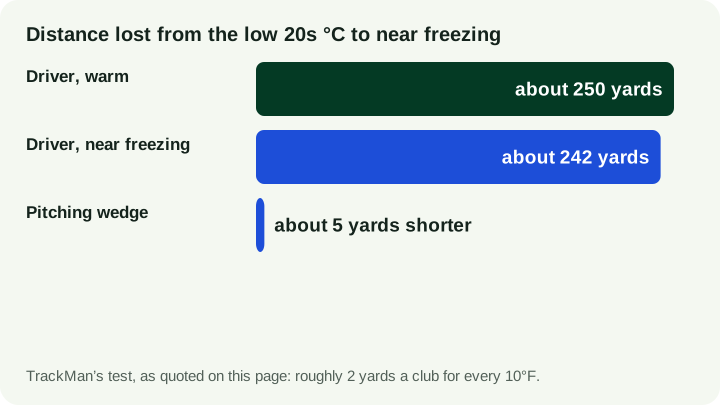
The clearest testing on this came from golf coach Andrew Rice, who ran players through a TrackMan launch monitor at a range of temperatures. The pattern held at roughly 2 yards a club for every 10°F drop, around 5.5°C, below 24°C. It matters more for a driver than a short iron: a driver hit around 250 yards in the low 20s Celsius came out closer to 242 yards near freezing, while a pitching wedge lost only around 5 yards over the same range, a little over half the driver's loss.
Gene Parente, who runs an independent equipment testing lab, puts the practical cut-off at around 13°C: below that, a ball's own performance starts to fall away regardless of the air. He also makes the point that a ball's core stays cold for a while after you take it out of a cold bag, so much so that it can take close to an hour indoors to properly warm back up. Two balls in a trouser pocket between holes is a small edge, not a fix.
When it stops being about the golf
None of that is a safety issue on its own. The NHS's guidance on hypothermia is that it happens when your body loses heat faster than it can make it, and that this can come from a short spell in genuinely cold conditions or a longer one in weather that isn't extreme but is cold, wet and windy, which describes plenty of North West winter mornings. Early signs are shivering, pale or cold skin and starting to feel tired or confused; severe hypothermia is a medical emergency. Wind makes any given temperature feel colder still, which is why a still, cold, dry morning is much easier than a similar temperature with a raw wind off the coast.
Frost, and our own cut-off
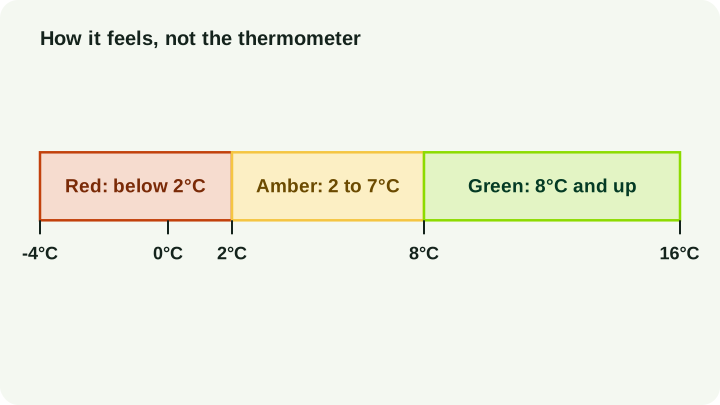
Frozen ground brings its own restrictions well before hypothermia is a real risk, which is why we cover frost delays separately. On our own hour-by-hour board, a round is marked amber once it feels below 8°C and red below 2°C, using the "feels like" temperature rather than the plain air reading, since that accounts for wind as well as the thermometer. It's a practical guide for planning a round, not a safety limit.
The Met Office's own figures for North West England show how much this varies by where you are: January's typically the coldest month, with mean daily minimums down around freezing over higher ground but closer to 2 to 2.5°C on the Merseyside and Lancashire coast. A coastal round in January is routinely a few degrees milder than the same morning twenty minutes inland towards the Pennines.
Checking before you go
The forecast temperature on its own doesn't tell you much. A still 4°C morning can be more comfortable than a breezy 8°C afternoon, because wind strips heat away far faster than cold air alone. That's the reason our board uses "feels like" rather than the plain air temperature: it folds wind into the number, which is closer to what you'll actually stand on the first tee and experience than the raw reading on a weather app.
For older golfers
The NHS lists older age as one of the things that raises the risk from cold, alongside being out in it for longer and getting wet. A full 18 holes in freezing, damp weather is a longer exposure than most people picture when they think "just a round of golf." Layering up, a hat, and being honest about cutting a round to nine holes if you're starting to feel it are all sensible, not soft.
Questions people ask
Do golf balls really go shorter in cold weather?
Yes. Cold air is denser and a cold ball compresses less off the clubface, so both the air and the ball work against you. Testing with TrackMan puts the loss at roughly 2 yards a club for every 10°F (about 5.5°C) the temperature drops, more for a driver than a wedge.
Does keeping the ball in my pocket really help?
A little. A ball's core takes time to warm back up once it's been sitting in a cold bag, and testers have found it can take close to an hour indoors to recover. Keeping a couple of balls in a trouser pocket between holes won't undo a freezing morning, but it stops them getting any colder.
What temperature counts as dangerously cold for golf?
There's no official figure. The NHS warning on hypothermia is about prolonged exposure to any cold, not a specific number, and it's more about wind, wet clothing and how long you're out there than the thermometer reading alone. Older golfers and anyone out for a full round in freezing, damp conditions are most at risk.
Can I still play if there's ice on the ground but not the greens?
Check with the club. Frozen fairways and paths can be fine to walk, but if the greens themselves are frozen the club will usually delay or move to temporary greens to stop the surface being damaged; that's covered on its own page.
Read next
Sources
- GOLF.com, "Here's a simple formula that calculates how far you'll hit it in cold weather", checked 23 September 2026
- GOLF.com, "How much does cold weather affect your golf ball? | Fully Equipped", checked 23 September 2026
- NHS, "Hypothermia", checked 23 September 2026
- Met Office, "North West England & Isle of Man: climate", checked 23 September 2026
Spotted something out of date? Email chris@ai-metric.com and we will check it against the source.