How the Golf Metric Weather Score works
Golf Metric starts at 100 and takes points off for rain, wind and temperature, using an hourly forecast from Open-Meteo. Thunder risk or not enough daylight before sunset overrides the number completely and marks the slot "Not recommended". Everything else is described below, exactly as the code runs it.
By Chris, Golf Metric · Updated 23 September 2026 · Facts checked 23 September 2026
The short version
Every tee time starts at a score of 100 out of 100. We take points off for rain, wind and temperature over the length of your round. Two things do not get scored at all: a thunderstorm risk, or not enough daylight to finish. Either one sets the slot to "Not recommended" no matter what the rest of the weather looks like.
What counts as "your round"
We score a window of 4 hours 15 minutes from your chosen tee time, which is what we assume an 18-hole round takes. It reads the hourly forecast for every hour inside that window: temperature, feels-like temperature, rain chance and amount, wind speed, gusts and cloud. If fewer than three hours of forecast fall inside the window, there is not enough data and we do not score it at all.
The two hard stops
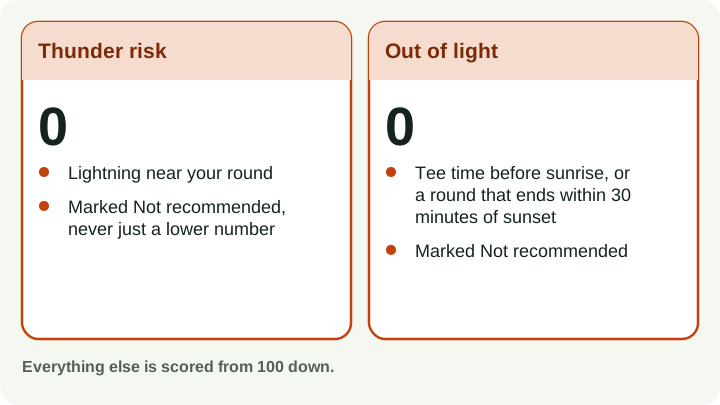
These come before any scoring and cannot be outscored by good weather elsewhere in the window.
Thunder. If any hour in the window is coded as a thunderstorm, or has both a high convective energy reading and a rain chance of 40% or more, the slot is marked "Not recommended" with the time the risk starts.
Daylight. We work out the day's sunset from the forecast, take off 30 minutes as a buffer, and check whether your round would finish before that. If your tee time is before sunrise, or a full round would finish after the 30-minute buffer, the slot is "Not recommended" and says what time you would overrun. Inside that limit, the page still tells you how much daylight you have to spare: "tight" under an hour, otherwise the buffer in hours.
Rain: how the points come off
We look at every hour in your round and work out the rain likely to fall, weighted by how likely it is, plus the single highest hourly chance, plus how many hours look properly wet (0.2 mm or more with at least a 50% chance). Add those together and the rain deduction is capped at 45 points.
In plain terms: a low chance of a passing shower barely touches the score. Rain that is likely for more than an hour of your round costs a lot more.
Wind: mean and gusts, scored separately
Wind takes points off in two parts. The average speed across your round starts costing points once it passes 8 mph, up to a cap of 20 points. The strongest gust in the window starts costing separately once it passes 18 mph, up to a cap of 25 points. A steady breeze and a gusty day are scored differently on purpose: gusts are what actually move the ball.
Temperature: feels-like, and colder costs more than hotter
Temperature is scored on the feels-like reading, averaged across your round. Below 6°C, every degree colder costs 2.5 points, up to a cap of 15. Above 25°C, every degree hotter costs 2 points, up to a cap of 10. Between 6°C and 25°C feels-like, temperature costs nothing. Cold is weighted harder than heat, because a cold, wet grip does more to a round than a warm one.
Putting it together: the score and the words
Score = 100, minus the rain deduction, minus the wind deduction, minus the temperature deduction, kept between 0 and 100. We then turn the number into a word: 80 or more is "Playable", 65 to 79 is "Playable, with notes", 45 to 64 is "Marginal", and under 45 is "Poor". A thunder or daylight stop is always "Not recommended", regardless of the number.
When you search a window rather than one tee time, we check every hour inside it and picks the best-scoring start, preferring a slot with no hard stop over one that has been forced to 0.
A worked example
Say a round is due to tee off at 09:00 in June, finishing by 13:15. Sunset that evening is 21:30, so the 30-minute buffer puts last light at 21:00, which is more than 7 hours clear of 13:15: no daylight problem, and no thunder in the forecast either.
Across the five hours of the round, the forecast shows a top hourly rain chance of 20% with only a trace of rain expected, average wind of 12 mph with gusts up to 22 mph, and an average feels-like temperature of 14°C.
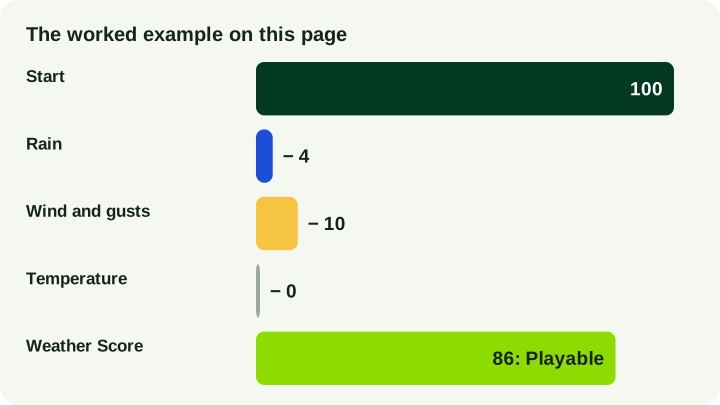
- Rain deduction: the chance and amount are both low, so this comes to 4 points.
- Wind deduction: 12 mph average is 4 mph over the 8 mph starting point (worth 5 points), and 22 mph gusts are 4 mph over the 18 mph starting point (worth roughly 4 more): 9 to 10 points in total.
- Temperature deduction: 14°C feels-like is inside the 6°C to 25°C band that costs nothing.
100 minus 4 minus 10 minus 0 comes to 86: "Playable", with the rain described as dry, the wind as 10 to 14 mph with gusts to 22 mph, and the temperature as 15°C, feels 14°C. These are invented figures to show the arithmetic, not a live forecast for a real date.
The hour-by-hour board
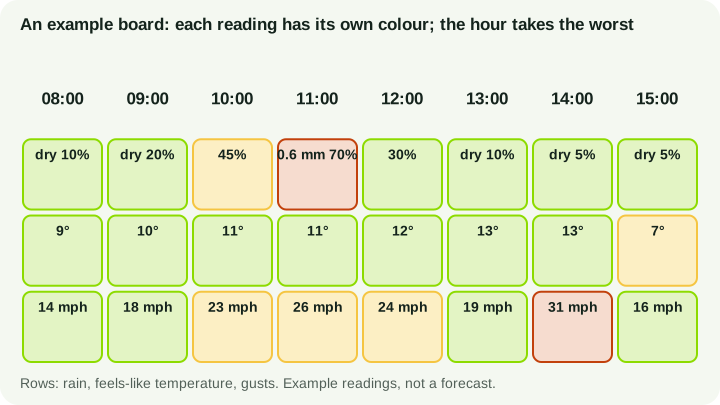
Course and range pages also show an hour-by-hour board, colouring each hour green, amber or red on its own, separately from the single round score above. An hour goes amber for rain from a 40% chance or 0.2 mm, and red from 1.5 mm, or 0.5 mm that is at least 60% likely, or a thunderstorm code. It goes amber for feels-like temperature under 8°C or 26°C and over, red under 2°C or 30°C and over. It goes amber for gusts of 22 mph or more, red from 30 mph. The hour's colour is whichever of the three is worst.
What the score does not know
It reads a weather forecast for one point on the map, nothing else. It does not know whether the course is actually open, whether there is a temporary green, a trolley ban, a frost delay, a maintenance closure or a private event that day. It cannot feel wind funnelled by trees or an exposed links hole any better than the forecast can. Always check with the course itself before you travel: every course page links to the club's own site.
Weather data by Open-Meteo.com.
Questions people ask
Where does the weather data come from?
Open-Meteo, a forecast service that blends national weather models. Golf Metric reads an hourly forecast for temperature, rain, wind and cloud, plus each day's sunrise and sunset, for the next 10 days. We credit them on every weather page: Weather data by Open-Meteo.com.
Why is a slot marked "Not recommended" even though the score looks fine?
Two things override the number completely: a thunderstorm risk in the window, or not enough daylight left to finish a round. Either one sets the slot to 0 and "Not recommended", whatever the rain and wind figures say.
Does the score know if the course is actually open?
No. It only reads the forecast for that point on the map. It cannot see frost delays, temporary greens, trolley bans, course closures, aeration work or a private event on the day. Always check with the course before you travel; our course pages link to each one's own site.
How far ahead does the weather score work?
Up to 10 days, which is as far as Open-Meteo's free forecast runs. Scores further out change more as the forecast updates, so it is worth checking again closer to the day.
Can I trust the score over my own judgement at the course?
Treat it as a starting point, not the final word. A forecast is for a single point and an hour block; the wind on an exposed links hole can feel stronger than the number on the page. Use it to plan the day, then look at the sky.
Read next
Sources
- Open-Meteo, forecast API documentation, checked 23 September 2026
- Open-Meteo, home page and data credit, checked 23 September 2026
Spotted something out of date? Email chris@ai-metric.com and we will check it against the source.