What to do if there's lightning on the golf course
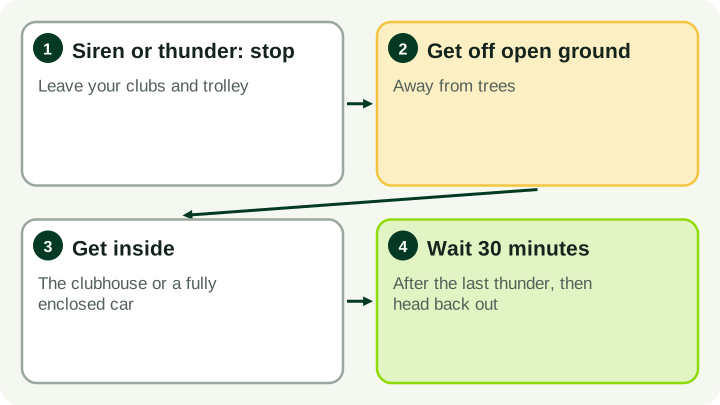
Stop playing straight away. Leave your clubs and trolley where they are, get off open ground and away from trees, and head for the clubhouse or a fully enclosed car. The standard safety advice is to wait until 30 minutes after the last thunder before you go back out, and under the Rules of Golf you're allowed to stop on your own if you believe there's a risk, even before an official suspension.
By Chris, Golf Metric · Updated 23 September 2026 · Facts checked 23 September 2026
What the rules actually say
Rule 5.7 of the Rules of Golf covers stopping and resuming play for a dangerous situation, and lightning is the example the Rules themselves use. If the committee calls an immediate suspension, everyone has to stop at once and stay stopped until told to resume; carrying on regardless can mean disqualification, unless the committee accepts the circumstances justified it.
The useful bit for anyone playing a casual round without a committee watching is Rule 5.7a: you're allowed to stop on your own if you reasonably believe there's a danger from lightning, without waiting for anyone's permission. You're expected to tell the committee as soon as you reasonably can afterwards, but nothing in the rules requires you to keep playing through a storm because nobody's blown a horn.
What to actually do
The safety advice from RoSPA, the UK's Royal Society for the Prevention of Accidents, comes down to the same handful of points wherever you read it:
- Use the 30/30 rule. Count the seconds between the lightning flash and the thunder. If it's 30 seconds or less, the storm is close enough to be dangerous: stop and get to shelter.
- Get inside a proper building or a fully enclosed car. A golf clubhouse counts; an open-sided shelter on the course generally doesn't.
- Leave your clubs and trolley behind. Metal conducts, and it does you no good to be holding a lightning rod. Set them down away from where you're sheltering, not on top of you.
- Stay away from trees. It feels like shelter, but RoSPA's figures put around a quarter of lightning casualties under a tree at the time. If a building or car is too far off, a low spot such as a bunker, crouched down, away from your clubs, is the better option of a bad set of choices.
- Stay off high or open ground. Fairways, greens and hilltops are exactly where you don't want to be caught.
- Wait 30 minutes after the last thunder you hear before you go back out, and restart that count if there's another flash or rumble before time's up.
Lightning is genuinely dangerous in Britain: RoSPA records 30 to 60 people struck each year, with around 5 to 10 percent of those strikes fatal. Golfers are regularly named as one of the higher-risk groups, simply because a round puts you on open, exposed ground, often near water, for hours at a time, carrying the one piece of kit you least want to be holding in a storm.
Thunderstorms in the North West
They're not the most common event here, which is part of the danger: it's easy to be caught unprepared. The Met Office's regional figures show thunder is most likely between May and September, peaking in July and August, with the mainland typically seeing 8 to 12 days of thunder a year. That's not a lot, but it's enough that a summer round is exactly when you're most likely to meet one, not the depths of winter.
Golf Metric's own hard stop
We treat this differently from every other weather factor on the board. Rain, wind and cold all move your round's score up or down. A thunderstorm in the forecast, or the kind of storm energy that's likely to build into one, does something else: it zeroes the slot outright and marks it "not recommended," whatever the rest of the hour looks like. It isn't a prediction that lightning will definitely strike your course, only that the conditions are the kind that produce it, and that's not a risk worth scoring around.
Getting caught out
If a storm builds faster than you expected and you're genuinely stuck between shelters, the same rules apply: away from trees, away from your clubs, off the highest ground you're on, and into the lowest, most enclosed spot available until it passes. It's an unglamorous way to spend twenty minutes, but it's a much better one than the alternative.
Questions people ask
Can I stop play myself if I think there's lightning risk, or do I need permission?
You can stop on your own. The Rules of Golf specifically allow a player to stop if they reasonably believe there's danger from lightning, without waiting for the committee, though you should let the committee know as soon as you reasonably can afterwards.
Is it true golfers are at higher risk from lightning?
Golfers are often named as a higher-risk group by safety organisations, for the obvious reasons: you're out on open, exposed ground with little shelter, sometimes near water, and carrying a bag of metal clubs. None of that causes lightning, but it removes the protection you'd have indoors or under cover.
Should I shelter under a tree if I can't get back in time?
No. RoSPA's guidance is clear that trees are one of the worst places to shelter, since around a quarter of people struck by lightning were sheltering under one at the time. A bunker, crouched low with your clubs left well away from you, is safer than a tree if you can't reach a proper building.
How long should I wait before going back out?
The standard rule used by safety bodies is 30 minutes after the last rumble of thunder you hear. If a new flash or clap resets that count before your 30 minutes are up, the clock starts again.
Read next
Sources
- The R&A, Rules of Golf, Rule 5.7 (Stopping and Resuming Play), checked 23 September 2026
- RoSPA, "Lightning safety", checked 23 September 2026
- Met Office, "North West England & Isle of Man: climate", checked 23 September 2026
Spotted something out of date? Email chris@ai-metric.com and we will check it against the source.