What wind speed is too windy for golf?
There's no rule that sets a wind limit for golf. In practice, once a steady wind or gusts get past 20 to 25 mph, most golfers start losing control of full shots and putts. Above 30 mph gusts, even good players struggle to keep the ball doing what they want.
By Chris, Golf Metric · Updated 23 September 2026 · Facts checked 23 September 2026
Why wind costs you more than it seems
A calm-day yardage on a scorecard is only true in calm air. TrackMan, the launch-monitor company most tours and coaches use to measure real shots, has tested this directly: at a steady 20 mph wind, a headwind costs a player roughly twice the distance that the same strength tailwind gives back. A shot into the wind climbs, spins harder and drops out of the sky early. A shot downwind flies flatter and doesn't gain nearly as much as you'd hope.
The effect isn't the same for every club. A low, punched shot barely notices a breeze that would blow a full wedge shot yards off line, because the higher and spinnier the shot, the longer the wind has to work on it. That's why good wind players tend to flight the ball lower rather than simply swinging harder.
Crosswind does the same job sideways: it pushes the ball off its line for as long as it's in the air, so again, the shot that hangs up there longest drifts furthest.
What each wind speed actually feels like
There's no rule that sets a cut-off for golf. The table below uses the Met Office's own Beaufort scale, the standard way UK wind speed is described, with a practical read on what each force means for a round.
| Beaufort force | Wind speed | Met Office term | What it means for golf |
|---|---|---|---|
| 3 | 8-12 mph | Gentle breeze | Barely worth a thought; flags lift, ball flight is normal |
| 4 | 13-18 mph | Moderate breeze | Worth a club more into the wind; putts start to drift on fast greens |
| 5 | 20-24 mph | Fresh breeze | Full shots move noticeably; standing over a putt gets harder |
| 6 | 25-31 mph | Strong breeze | Wedges and high shots are hard to control; balance affected on the tee |
| 7 | 32-38 mph | Near gale | Most golfers are losing more shots to the wind than to their swing |
| 8+ | 39 mph+ | Gale | Clubs generally aren't playable; a resting ball can be blown off the green |
Gusts matter more than the steady speed for golf, because it's the sudden jump that catches a ball mid-flight or a stance mid-swing. A round with a gentle 12 mph breeze and the odd 30 mph gust plays harder than a steady 20 mph with no gusts at all.
Exposed by the coast
The North West sits on the western, Atlantic-facing side of the country, and the Met Office's regional figures for North West England confirm what anyone who's played Southport or the Fylde coast in a February wind already knows: the region has a prevailing south-westerly wind through the year, and the exposed coast sees more wind than sheltered inland spots. Coastal areas here average five to ten days of gale-force wind a year; low-lying inland ground gets fewer than five.
Links courses (built on sandy ground by the sea) sit right in that exposure, with little in the way of trees to take the edge off. That's part of what makes links golf what it is, for better and for worse depending on your tee time.
Checking before you go
Our hour-by-hour board on each course page shows wind speed and gusts for your tee time, colour-coded so you can see at a glance when a round is likely to turn into hard work rather than a nice walk.
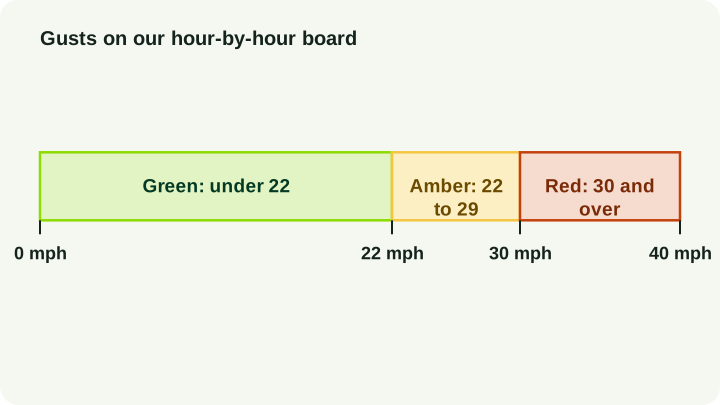
It won't tell you exactly how much distance you'll lose on your 7-iron, but it will tell you whether it's worth the drive.
For older golfers
Balance in a strong gust is as much the issue as ball flight. If footing on an exposed tee feels unsteady in wind, there's no harm in teeing off from a sheltered spot on the tee box, or simply choosing a calmer day if the course allows a flexible booking.
Questions people ask
Does wind affect putting as well as full shots?
Yes, more than most golfers expect. A strong gust can shift a ball that's already moving on a fast green, and it makes it harder to settle over the putt in the first place. It's less dramatic than the effect on a full swing, but on an exposed green it's real.
Why does a headwind cost you more than a tailwind gives you?
A headwind increases the ball's effective spin and steepens its landing angle, so it loses energy faster than a tailwind adds it. TrackMan's own data puts a strong headwind's penalty at close to double the benefit of the same tailwind.
Can a club stop play just because it's windy?
The Rules of Golf let a committee suspend play for a dangerous situation, and a gale strong enough to move a ball at rest or blow someone off their feet could count. Short of that, deciding wind is too much is usually down to the individual golfer, not the club.
Is wind worse on a links course than a parkland one?
Generally yes. Links courses (built on sandy ground by the sea) sit open to the coast with few trees, so the wind reaches you at full strength. Parkland courses inland, with more tree cover, usually take some of the edge off.
Read next
Sources
- TrackMan, "Understanding TrackMan's Golf Normalization Feature", checked 23 September 2026
- The R&A, Rules of Golf, Rule 5.7 (Stopping and Resuming Play), checked 23 September 2026
- Met Office, marine and coastal forecast guide (Beaufort scale table), checked 23 September 2026
- Met Office, "North West England & Isle of Man: climate", checked 23 September 2026
Spotted something out of date? Email chris@ai-metric.com and we will check it against the source.