How late can you tee off and still finish before dark?
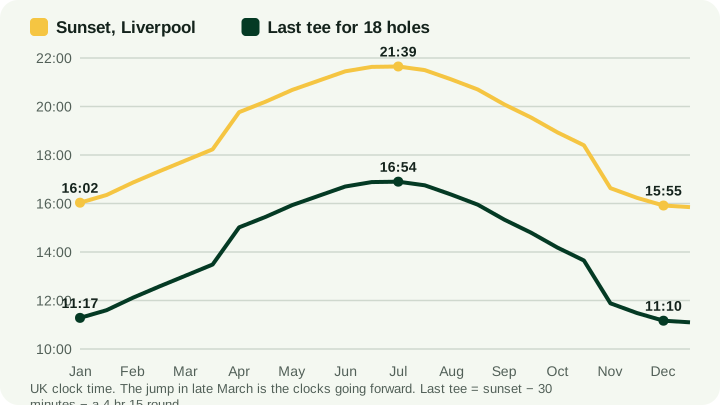
It depends on the date. In midwinter you need to be off by around 11:15 for 18 holes; by midsummer that stretches past 16:45. The table below gives the latest sensible tee time for every fortnight of the year, working back from sunset.
By Chris, Golf Metric · Updated 23 September 2026 · Facts checked 23 September 2026
The table
Last tee times below assume an 18-hole round takes 4 hours 15 minutes and a 9-hole round takes 2 hours 15 minutes, with 30 minutes of spare daylight built in after the round finishes. Times are UK clock time (GMT in winter, BST in summer). Sunset varies a little across the region, so three towns are given: Liverpool for Merseyside, Lancaster for north Lancashire, and Chester for Cheshire.
| Date | Sunset, Liverpool | Last tee, 18 holes | Last tee, 9 holes | Sunset, Lancaster | Sunset, Chester |
|---|---|---|---|---|---|
| 1 Jan | 16:02 | 11:17 | 13:17 | 15:57 | 16:03 |
| 15 Jan | 16:21 | 11:36 | 13:36 | 16:17 | 16:21 |
| 1 Feb | 16:52 | 12:07 | 14:07 | 16:48 | 16:52 |
| 15 Feb | 17:20 | 12:35 | 14:35 | 17:17 | 17:20 |
| 1 Mar | 17:47 | 13:02 | 15:02 | 17:45 | 17:47 |
| 15 Mar | 18:14 | 13:29 | 15:29 | 18:13 | 18:13 |
| 1 Apr | 19:44 | 14:59 | 16:59 | 19:44 | 19:44 |
| 15 Apr | 20:10 | 15:25 | 17:25 | 20:10 | 20:09 |
| 1 May | 20:38 | 15:53 | 17:53 | 20:40 | 20:37 |
| 15 May | 21:03 | 16:18 | 18:18 | 21:05 | 21:01 |
| 1 Jun | 21:28 | 16:43 | 18:43 | 21:31 | 21:26 |
| 15 Jun | 21:41 | 16:56 | 18:56 | 21:44 | 21:39 |
| 1 Jul | 21:43 | 16:58 | 18:58 | 21:47 | 21:42 |
| 15 Jul | 21:34 | 16:49 | 18:49 | 21:37 | 21:32 |
| 1 Aug | 21:10 | 16:25 | 18:25 | 21:12 | 21:09 |
| 15 Aug | 20:43 | 15:58 | 17:58 | 20:44 | 20:42 |
| 1 Sept | 20:04 | 15:19 | 17:19 | 20:05 | 20:04 |
| 15 Sept | 19:30 | 14:45 | 16:45 | 19:30 | 19:30 |
| 1 Oct | 18:51 | 14:06 | 16:06 | 18:50 | 18:51 |
| 15 Oct | 18:18 | 13:33 | 15:33 | 18:16 | 18:18 |
| 1 Nov | 16:42 | 11:57 | 13:57 | 16:39 | 16:42 |
| 15 Nov | 16:17 | 11:32 | 13:32 | 16:14 | 16:17 |
| 1 Dec | 15:58 | 11:13 | 13:13 | 15:54 | 15:59 |
| 15 Dec | 15:53 | 11:08 | 13:08 | 15:48 | 15:54 |
Notice the jump between 15 March and 1 April: that is the clocks going forward for British Summer Time, which moves every time on the table an hour later overnight, not a sudden change in daylight.
How the last tee time is worked out
Take the sunset for the day, subtract 30 minutes so you are off the course with light to spare, then subtract the length of your round. For 18 holes that is 4 hours 15 minutes; for 9 holes it is 2 hours 15 minutes. Tee off any later than that and you are finishing in fading light or worse, in the dark.
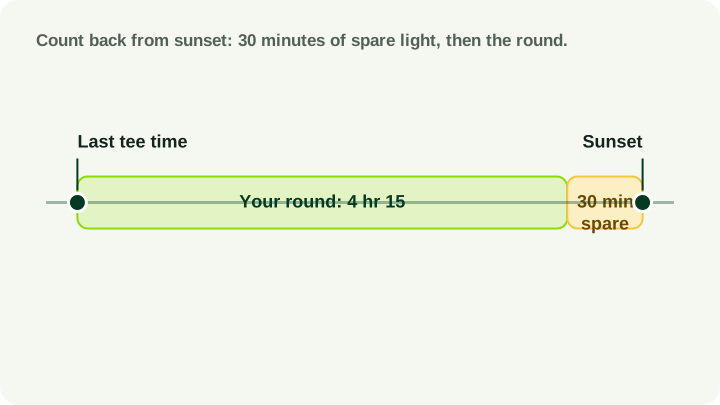
The 30-minute buffer is our own margin, not an official figure from anywhere. It covers the last few minutes of usable light before the sun is technically down, the time it takes to hole out and walk off, and a bit of slack if the round overruns slightly.
Why round length matters more than you think
We assume 4 hours 15 minutes for 18 holes, which is on the brisk side of normal. The R&A's own Pace of Play Manual works from baseline times of 10 minutes for an average par 3, 13 minutes for a par 4 and 16 minutes for a par 5, for a four-ball, before any adjustment for a longer course or a tricky walk between holes. Add those up for a typical par-72 layout and you are already close to 4 hours before accounting for a busy course, a search for a ball, or a slow group ahead. The R&A is clear there is no single correct time for every course, but the lesson holds everywhere: if your group usually runs long, move your last sensible tee time earlier than the table shows, not later.
Using the table
Find the nearest date, then read down to whichever town is closest to your round. If you are playing a 9-hole course, or the front or back 9 of a bigger one, use the 9-hole column instead. Then work backwards from your own start time to check you are inside it, especially late in a round booked for late afternoon in autumn or winter, when the last tee time can be more than an hour earlier than it was only a fortnight before.
For a specific date, the weather score on each course page reads the actual forecast sunset for that day rather than this table, so it is worth checking again closer to the day; see how the weather score works for the detail.
Questions people ask
Where do these times come from?
We work them out from sunset for Liverpool, Lancaster and Chester, using a standard sunset formula, then take off a 30-minute buffer and the length of a round. They are planning figures, not a forecast for one specific day.
Why take 30 minutes off sunset rather than teeing off right up to it?
That is our own margin, not an official figure. It allows for the light fading before the sun is actually down, for the last putt to drop, and for the walk back in. Treat it as a buffer, not a guarantee, and build in more of one yourself in poor visibility or fog.
What if my round usually takes longer than 4 hours 15 minutes?
Tee off earlier. The table assumes 4 hours 15 minutes for 18 holes and 2 hours 15 minutes for 9. A slow fourball, a search for a lost ball, or a busy course can add 30 minutes or more, and none of that gets any easier once the light starts going.
Does the live weather score on a course page use this same table?
No. The score on each course page reads the actual forecast sunset for your chosen date from Open-Meteo, which is more accurate for one specific day. This table is for planning weeks ahead, before a forecast is even available.
Will these times still be right next year?
Close enough for planning. Sunset shifts by a minute or two from year to year, so the table, worked out for 2027, is a reliable guide for any nearby year. For a tee time that matters, check the live score closer to the day.
Read next
Sources
- The R&A, Pace of Play Manual, Appendix C: Time Par, checked 23 September 2026
Spotted something out of date? Email chris@ai-metric.com and we will check it against the source.