How long does a round of golf take?
There's no single official time for a round. The R&A's own pace-of-play guidance says each course sets its own target rather than following one universal figure, but its worked examples give a sense of scale: a three-ball should complete nine holes in under 1 hour 45 minutes in stroke play, and tee times are usually spaced 8 to 12 minutes apart depending on group size. Eighteen holes broadly doubles that.
By Chris, Golf Metric · Updated 23 September 2026 · Facts checked 23 September 2026
There's no official answer
The R&A, golf's rule-making body outside the US and Mexico, publishes a whole manual on pace of play and still won't give one figure for how long a round should take. Its own guidance is blunt about it: "there is no single target for everyone to aim towards" and "each facility has to set its own targets" based on its own conditions. What it does publish are the building blocks you can use to estimate a round yourself.
Tee-time intervals
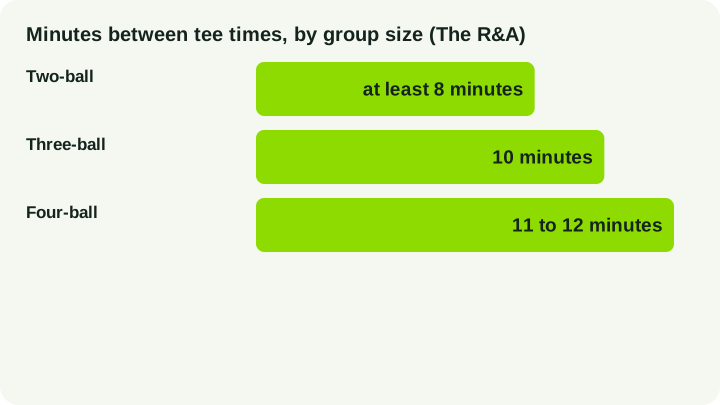
The R&A recommends spacing tee times further apart as groups get bigger: at least 8 minutes between two-balls, at least 10 minutes for three-balls, and 11 to 12 minutes for four-balls. That's the gap between groups teeing off, not the length of a round, but it's a fair proxy for how much longer a bigger group takes to get round.
| Group size | Recommended tee interval |
|---|---|
| Two-ball | At least 8 minutes |
| Three-ball | At least 10 minutes |
| Four-ball | 11 to 12 minutes |
Nine holes: a worked example
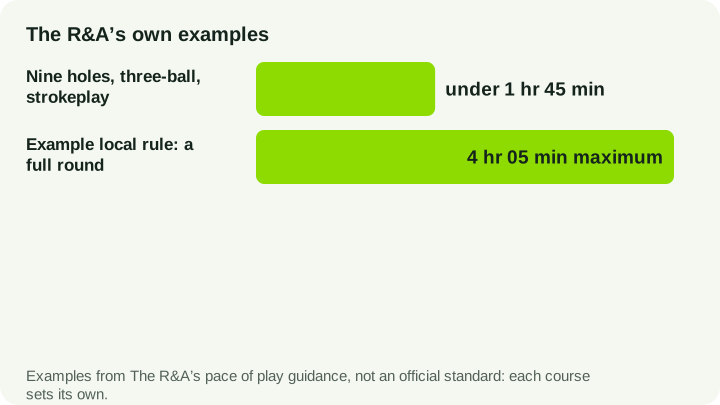
The R&A's own example states that "a group of three playing stroke play should not take more than 1 hour 45 minutes to complete nine holes". A two-ball would usually be a little quicker again. Eighteen holes broadly doubles the nine-hole figure for the same group size and course, though The R&A doesn't publish an official 18-hole equivalent; its Appendix H, on model local rules, gives an example maximum time of "4 hours and 05 minutes" for clubs to adapt, explicitly as an illustration rather than a standard.
What actually slows a round down
The R&A's own manual ranks three causes, and player behaviour isn't the main one.
Management practices come first: "providing insufficient time between groups teeing off" causes groups to bunch up and overcrowd the course behind them.
Course setup is next: rough growing right up to the fairway, greens cut too fast, or too few teeing options for weaker players all add time that no amount of quick play can fix.
Player behaviour matters too, but The R&A calls it "relatively insignificant when compared to the impact that poor management practices and ill-considered course set up can have". Its own examples of what to avoid include marking your scorecard on the green when the group behind is waiting, measuring an exact yardage when an estimate would do, and reading a putt from several angles. The R&A's maths: saving 5 seconds a shot across 80 shots in a four-ball saves 26 minutes 40 seconds over a round.
Playing faster yourself
Be ready to play when it's your turn, walk to your ball while your playing partners are hitting theirs rather than after, and play a provisional ball if there's a real chance the first one is lost, since ball searches are one of The R&A's named causes of delay. Four-balls are naturally slower than two-balls; The R&A's own advice is to avoid them when pace is a concern.
For juniors and older golfers
A full 4-hour-plus round is a long time to concentrate or stay on your feet, whatever your age. None of The R&A's guidance above is age-specific, but a nine-hole round at roughly half the time is a practical way to keep a junior's first few rounds shorter, or to manage a round for an older golfer building fitness back up. See our page on nine-hole golf in the North West for where to play one.
Finishing before it gets dark
None of this tells you what time you need to tee off to finish in daylight. Our last tee time before dark page has a month-by-month table for the North West, built around a 4 hour 15 minute round for 18 holes and 2 hours 15 minutes for 9, with 30 minutes of spare light built in.
Questions people ask
How long does 18 holes take?
It depends on group size and how busy the course is; The R&A deliberately doesn't publish one figure. As a guide, its own model local rule for a maximum round time gives an example of "4 hours and 05 minutes", though it's explicit that this is an illustration for clubs to adapt, not a standard.
How long does 9 holes take?
The R&A's own example puts a three-ball at no more than 1 hour 45 minutes for nine holes in stroke play. A two-ball is usually quicker; see our page on nine-hole golf in the North West for where to play a short round.
What slows a round down the most?
According to The R&A, management practices and course setup matter more than player behaviour: tee times spaced too close together, or a course with thick rough next to the fairway and fast greens, will slow every group down regardless of how anyone plays.
What can I do to play faster myself?
The R&A's own advice is to be ready to play when it's your turn, walk to your ball while others are playing theirs, and avoid unnecessary precision like measuring exact distances or reading a putt from several angles when it isn't needed. It calculates that saving just 5 seconds a shot across 80 shots in a four-ball saves nearly 27 minutes.
Does a bigger group play slower?
Yes. The R&A recommends longer tee-time intervals for bigger groups, at least 8 minutes for a two-ball, 10 for a three-ball and 11 to 12 for a four-ball, and its own guidance suggests avoiding four-balls altogether when pace of play is a concern.
Read next
Sources
- The R&A, Pace of Play Manual, "1. Introduction", checked 23 September 2026
- The R&A, Pace of Play Manual, "2. Management Practices", checked 23 September 2026
- The R&A, Pace of Play Manual, "4. Player Behaviour", checked 23 September 2026
- The R&A, Pace of Play Manual, "6. Appendices", checked 23 September 2026
Spotted something out of date? Email chris@ai-metric.com and we will check it against the source.